Domestic Help vs Senior Community: A Practical Risk Comparison for Families
A practical comparison for families deciding whether domestic help is enough or whether an ageing parent now needs backup, records, emergency response, and community support.
Quick Answer
Domestic help is useful for cooking, cleaning, errands, routine familiarity, and companionship, but it is not automatically an elder-care system. Families should compare the parent's actual needs against the helper's scope, training, backup, night coverage, medicine process, emergency response, documentation, supervision, privacy, cost, and social life. A senior community becomes worth evaluating when one helper has become the single point of failure, the family is managing repeated crises, medicines or falls are poorly tracked, or the parent needs daily observation and peer routine beyond domestic chores.
Family safety note
This guide is educational and does not replace advice from qualified doctors, legal professionals, financial advisors, emergency responders, or licensed care providers. If a parent is in immediate danger, has a sudden health change, confusion, chest pain, breathing difficulty, fall injury, self-harm risk, abuse risk, or unsafe living condition, seek urgent local help.
4 roles
to separate
Domestic work, personal care, medical coordination, and emergency response are different responsibilities.
2 backups
to name
Name backup help and family escalation before the regular helper is absent.
1 log
for visibility
Use a daily note for food, medicines, mood, falls, visitors, and concerns.
Do not confuse presence with a care system
A trusted helper can be deeply valuable. They may know the parent's food habits, daily rhythm, house, neighbours, and moods better than anyone else. Families should not dismiss that relationship.
The problem begins when presence is mistaken for qualified, backed-up care. Cooking, cleaning, and companionship are not the same as medicine management, fall response, dementia supervision, infection precautions, hospital discharge support, or emergency decision-making.
Define the helper's actual scope
Write down what the helper is expected to do and what they are not expected to do. A domestic worker may prepare meals, clean, run errands, supervise routine, and call the family if something changes. That is different from administering medicines, lifting after a fall, handling wounds, or deciding hospital transfer.
If the family expects medical or personal-care tasks, use trained support and written instructions. Otherwise the helper is being placed in an unfair and unsafe role.
Check the single-point failure risk
The most common hidden risk is one-person dependency. If one helper is absent, ill, unavailable at night, leaves suddenly, or cannot manage a crisis, the entire arrangement can collapse.
Ask what happens on the first day without that helper. Who cooks, who checks medicines, who opens the door for a doctor, who calls an ambulance, who stays in hospital, and who updates NRI or outstation children?
Build a home-care operating system if staying home
If the parent stays at home with domestic help, the family must create the system around the helper: verified identity, written scope, emergency contact sheet, medicine list, doctor numbers, daily log, backup worker, family visit schedule, and clear instructions for when to call for help.
This is especially important for NRI children because small changes can be invisible from a distance. A simple daily note on food, medicines, mood, walking, bowel issues, sleep, visitors, and concerns gives the family a pattern instead of scattered calls.
Know when a senior community should be evaluated
A senior community should be considered when the parent's needs have moved beyond chores: recurring falls, unsafe nights, missed medicines, poor meals, repeated hospital visits, loneliness, declining mobility, helper turnover, or a local sibling reaching burnout.
The point is not that community is always better. The point is that a community can offer shared meals, staff coverage, walking routes, documented response, family updates, peer contact, and escalation systems that one home helper may not be able to provide.
Compare accountability, not only monthly cost
Domestic help often looks cheaper than senior living because many costs are hidden: family supervision, emergency travel, replacement help, hospital attendants, medicine errors, home modifications, and the unpaid time of local relatives.
Compare total support. Home may still be the right answer if the parent is stable and the family can supervise well. A community may be better if the family is buying structure, backup, food rhythm, response, and social life that cannot be reliably created at home.
Use hybrid support carefully
Some families need a hybrid model: domestic help at home plus trained nursing visits, or a senior community with a personal attendant where allowed. The details matter.
Ask who supervises outside attendants, who keeps records, who handles medicine changes, whether night coverage exists, and whether the arrangement improves the parent's dignity rather than simply adding more people around them.
Comparison checklist for domestic help and senior community care
Parent's current risk level
List falls, missed medicines, low appetite, confusion, isolation, night risk, hospital visits, and caregiver burnout before comparing options.
Domestic task scope
Separate cooking, cleaning, errands, companionship, bathing help, mobility support, medicine reminders, and emergency decisions.
Helper verification and supervision
Verify identity, references, duties, working hours, leave rules, replacement plan, and who supervises quality.
Medicine process
Clarify who stores medicines, who reminds or administers, who records missed doses, and who updates prescriptions after doctor visits.
Night and absence backup
Name who checks the parent when the helper is absent, late, sick, on leave, or unavailable after dark.
Emergency pathway
Keep ambulance, hospital, doctor, neighbour, local relative, and family escalation instructions visible and current.
Family visibility
Use a daily or weekly log for food, medicines, mood, sleep, walking, visitors, incidents, and concerns.
Social routine
Compare whether the parent has peers, shared meals, movement, prayer, activities, and reasons to leave the room.
Home safety
Check bathroom rails, lighting, flooring, bed height, walking path, kitchen risk, door access, and emergency call method.
Senior community operating model
Ask who responds, what is documented, how family is updated, what medical help exists, and where care limits are drawn.
Total cost
Compare helper salary, backup help, nursing visits, emergency travel, hospital attendants, modifications, supervision time, and community fees.
Dignity and preference
Ask where the parent feels safer, less lonely, less watched, more respected, and more able to keep their routine.
Which model fits which situation?
| Care Area | What to Watch | Family Action |
|---|---|---|
| Stable parent needing household help | Parent can direct the helper, walk safely, manage medicines, and call family when needed. | Domestic help may work if duties, backup, verification, and emergency contacts are clear. |
| Parent needs bathing or mobility support | Transfers, bathroom safety, fall risk, privacy, and helper training become central. | Use trained support and written instructions; do not assume a domestic worker can safely lift or bathe. |
| Medicines are often missed | Multiple prescriptions, changing doses, side effects, and no reliable documentation. | Create a medicine log or evaluate a setting with documented medicine support and family updates. |
| Night risk is rising | Falls, bathroom trips, confusion, chest pain, breathlessness, or no one available after dark. | One daytime helper is not enough; compare night backup, emergency response, and community coverage. |
| Parent is isolated | Meals alone, low movement, little conversation, no peers, and declining motivation. | Compare social rhythm honestly: shared meals, activities, prayer, walking, and resident voice matter. |
| Helper turnover is frequent | Every replacement requires retraining, trust rebuilding, and family supervision. | Assess whether the home model is now too fragile and whether structured support would reduce crises. |
| NRI children manage from afar | Family learns about problems late or only through crisis calls. | Require written logs, named local backup, and clear escalation; if that cannot be built, evaluate a community. |
| Post-hospital recovery | Weakness, wound care, medicine changes, infection risk, follow-up visits, and diet changes. | Use trained recovery support or a setting that can coordinate medical follow-up and daily observation. |
| Memory or wandering concern | Unsafe cooking, leaving home, missed medicines, suspicion, or confusion after evening. | Domestic help may be insufficient unless supervision, safety, and clinical guidance are structured. |
| Family wants a hybrid model | Outside attendant plus community or home helper plus nurse may blur responsibility. | Clarify who supervises, documents, escalates, pays, and protects the parent's privacy. |

Decision lens
People help; systems prevent avoidable crises
The right answer is not home versus community in theory. It is whether the current arrangement has enough backup, records, response, supervision, and social rhythm for the parent's actual needs.
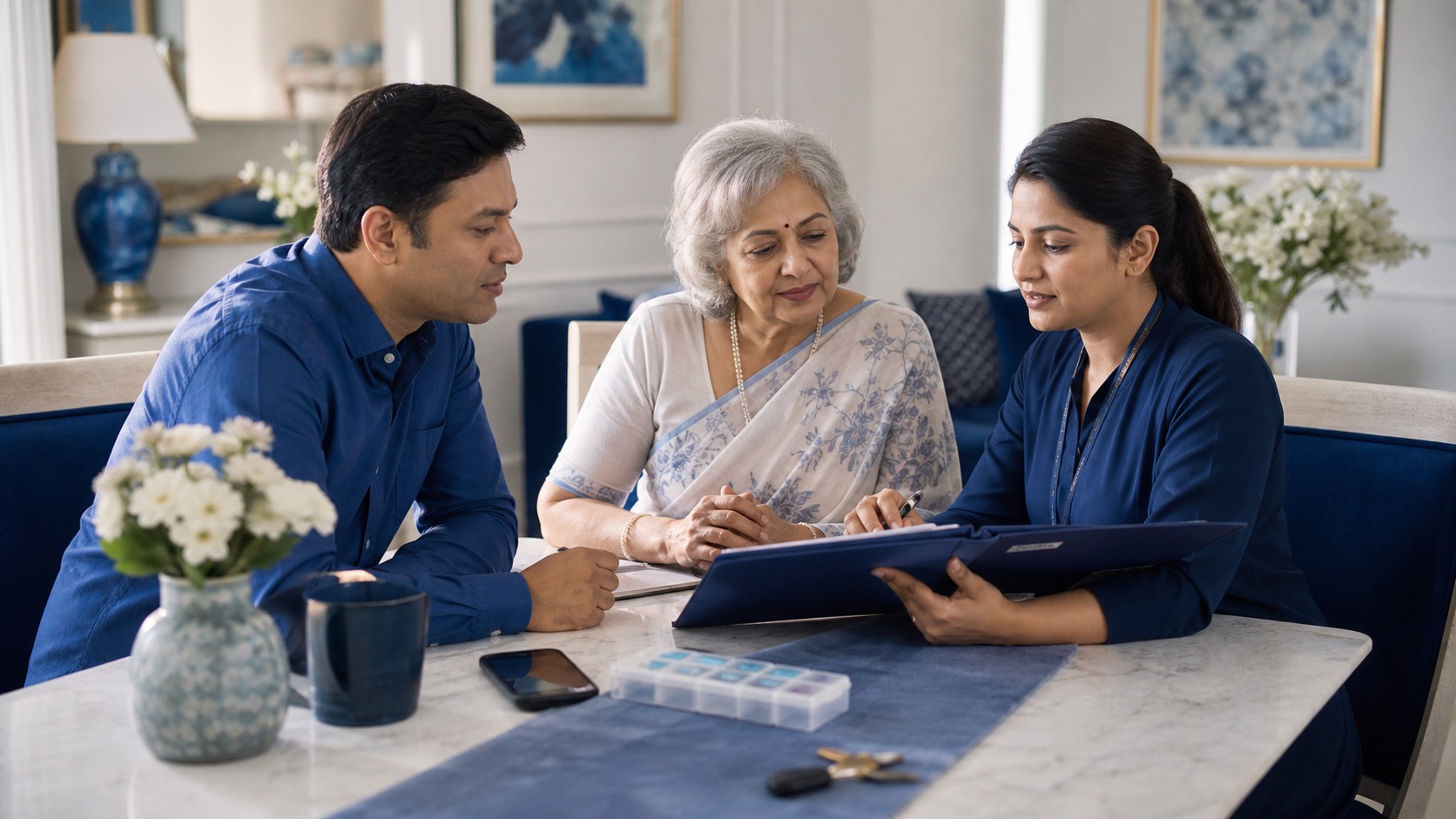
Family care scenes
The right answer is not home versus community in theory. It is whether the current arrangement has enough backup, records, response, supervision, and social rhythm for the parent's actual needs.


At a glance
- Parent's current risk level: List falls, missed medicines, low appetite, confusion, isolation, night risk, hospital visits, and caregiver burnout before comparing options.
- Domestic task scope: Separate cooking, cleaning, errands, companionship, bathing help, mobility support, medicine reminders, and emergency decisions.
- Helper verification and supervision: Verify identity, references, duties, working hours, leave rules, replacement plan, and who supervises quality.
- Medicine process: Clarify who stores medicines, who reminds or administers, who records missed doses, and who updates prescriptions after doctor visits.
- Night and absence backup: Name who checks the parent when the helper is absent, late, sick, on leave, or unavailable after dark.
Questions families ask
Is domestic help unsafe for seniors?
Not necessarily. A trusted helper can be excellent for routine support. The risk comes when families expect one helper to manage medical, emergency, night, or dementia-related responsibilities without training, backup, or supervision.
When should family stop relying only on domestic help?
Reconsider the model after falls, missed medicines, night scares, helper absence, repeated hospital visits, poor meals, social isolation, local caregiver burnout, or when NRI children cannot get reliable updates.
Can families use both domestic help and a senior community?
Sometimes. Policies differ, so families should ask whether outside attendants are allowed, who supervises them, how records are kept, and who is responsible when the attendant and community staff disagree.
What is the biggest hidden risk?
One-person dependency. If one helper holds the whole arrangement together, absence, illness, turnover, or a night emergency can expose that there was no real system behind the care.
Is a senior community always better than home?
No. Home can be better when the parent is stable, wants to stay, and the family can create reliable backup and supervision. A community is worth evaluating when the needed structure cannot be created at home.
What should NRI children ask first?
Ask who sees the parent daily, who verifies medicines, who responds at night, who replaces the helper, who keeps written notes, and who can reach the hospital before the family arrives.
Sources