A practical response playbook for families: door access, visible records, local responders, medicines, hospital folder, helplines, and post-incident review.
Quick Answer
An emergency plan for an elderly parent living alone must work when the parent cannot speak clearly, unlock the door, remember medicines, or explain symptoms. Keep one visible emergency sheet, a safe access method, three named local responders, a current medicine list, doctor and hospital details, 112 and Elderline 14567 information, transport rules, a hospital folder, and a written rule for when the family must travel or move the parent into more supported care.
Family safety note
This guide is educational and does not replace advice from qualified doctors, legal professionals, financial advisors, emergency responders, or licensed care providers. If a parent is in immediate danger, has a sudden health change, confusion, chest pain, breathing difficulty, fall injury, self-harm risk, abuse risk, or unsafe living condition, seek urgent local help.
1
visible sheet
A responder should find the parent's essentials without opening cupboards or searching WhatsApp.
3
local responders
Name a primary visitor, a backup visitor, and a hospital escort before the first crisis.
10 min
drill
Test the plan by asking someone local to find the sheet, call sequence, keys, and hospital folder.
An emergency plan must work when the parent cannot explain
A weak emergency plan assumes the parent will answer the phone, unlock the door, describe symptoms, remember medicines, and choose the right hospital. That is exactly what may fail during a fall, stroke-like symptom, fever, low sugar episode, breathlessness, sudden confusion, or panic.
The test is simple: if a neighbour, building guard, local relative, driver, or community staff member reaches the door, can that person act in the first 15 minutes without waiting for an NRI child to wake up, search files, or debate siblings?
This is not about taking control away from a parent. It is about protecting their choices when they are least able to repeat them.
Create the one-page visible emergency sheet
The most useful document is not a long folder. It is one printed sheet placed where a responder can see it: near the main door, refrigerator, medicine drawer, or bedside table. Keep a second copy inside the hospital folder and a digital copy shared with the family.
Write the parent's full name, age, preferred language, address landmark, diagnoses, allergies, current medicines with doses, mobility limit, hearing or vision issue, primary doctor, preferred hospital, blood group if confirmed, insurance or scheme details, and the top emergency contacts in call order.
The sheet should also say what the parent refuses or prefers where known: hospital choice, who may speak to doctors, religious or food requirements during admission, and who should not be treated as a decision maker.
Solve door access before the first no-answer call
Many emergencies become worse because the parent is inside, the family is outside the city or country, and nobody is authorized to enter. Decide the access rule while the parent is well.
A workable access plan can include a trusted neighbour or relative key, building office permission, a sealed key envelope, a smart lock code with strict sharing rules, or a senior community response desk. Avoid casual key sharing without consent, documentation, and a backup if the first person is unavailable.
For a no-answer call, write a timed sequence: call twice, call the neighbour, call the building guard, send the local responder, check hospital or clinic visits, and then use emergency services if there is a credible risk. The rule should be written, not improvised during panic.
Build a responder chain, not a contact list
A contact list is passive. A responder chain assigns jobs. The first person physically checks the parent. The second person stays reachable if the first is unavailable. The hospital escort carries documents and stays through registration. One family member communicates with doctors. One family member updates siblings so the local responder is not flooded with calls.
NRI families should also decide the overseas rule: who stays awake on the call, who books travel if admission happens, who pays the first deposit, and who sends the concise update to the wider family. If every sibling calls the hospital separately, care becomes slower.
Share only the information each person needs. A neighbour may need doctor and family numbers, but not bank details. A hospital escort may need ID, insurance, prescriptions, and consent contacts.
Use symptom-specific escalation rules
Do not reduce every emergency to the same instruction of call someone local. Write separate rules for no answer, fall, chest pain, breathlessness, sudden weakness, sudden confusion, high fever, medicine mistake, missed meals, and helper absence.
For severe symptoms, delayed response is the enemy. Use emergency medical services and local health care rather than waiting for a remote family discussion. In India, 112 is the national emergency response number, while families should also keep local ambulance, hospital emergency desk, doctor, and building response numbers because availability can vary by city and situation.
For falls, the family rule should prevent two common mistakes: dismissing a near-fall as normal ageing, and pulling an injured parent up quickly without checking pain, head injury, dizziness, or inability to bear weight. After any fall, ask the doctor to review medicines, blood pressure, vision, footwear, walking support, bathroom safety, and night lighting.
Prepare the hospital folder and go-bag
The hospital folder should be boring, current, and easy to carry. Include ID copy, insurance card or policy, Ayushman or other scheme details if relevant, previous discharge summaries, latest test reports, prescriptions, allergy note, doctor list, vaccination note where relevant, and the emergency sheet.
The go-bag should include spectacles, hearing aid batteries or charger, phone charger, basic toiletries, a change of clothes, slippers with grip, a small notebook, pen, and a list of valuables carried. Do not keep large cash or jewellery in it.
The medicine list matters more than a bag of loose strips. Write generic and brand names where possible, dose, timing, purpose, start date if known, and who prescribed it. Include over-the-counter medicines, eye drops, supplements, and herbal products because they can affect treatment decisions.
After every emergency, change the living plan
The emergency is not over when the parent returns home. The family must ask what failed: delayed access, missing records, medicine confusion, unsafe bathroom, helper absence, poor nutrition, loneliness, transport delay, or no local escort.
A single incident may need a small fix. Repeated incidents need a bigger care decision: daily check-ins, meal support, medicine supervision, physiotherapy, local care manager, short recovery stay, assisted living review, or moving closer to reliable family.
The point is not to punish independence. The point is to stop treating each crisis as isolated when the pattern is saying the home system has become too fragile.
Emergency plan packet for a parent living alone
01Visible emergency sheet
One page with identity, address landmark, diagnoses, allergies, medicines, doctors, hospital, and call order.
02Door access protocol
Key holder, backup key, building permission, lock code rule, and what to do during a no-answer call.
03Responder sequence
Primary local visitor, backup visitor, hospital escort, doctor communicator, and family update owner.
04Current medicine list
Prescription, OTC, eye drops, supplements, dose, timing, purpose, prescribing doctor, and known side effects.
05Hospital folder
ID, insurance or scheme details, discharge summaries, test reports, prescriptions, allergies, and doctor list.
06Transport plan
Preferred ambulance, hospital emergency desk, driver backup, route notes, and who rides with the parent.
07NRI update script
A short message format: what happened, where parent is, doctor status, next decision, money needed, and next update time.
08Home risk map
Bathroom, stairs, kitchen, gas, rugs, balcony, night lighting, walking aid, and where falls have nearly happened.
09Post-incident review
Write what failed, what changed, who owns the fix, and whether living alone still has enough backup.
Emergency scenarios and first response
| Care Area | What to Watch | Family Action |
|---|
| No answer | Missed scheduled call, phone switched off, doorbell unanswered | Follow the timed call, neighbour, guard, responder, and emergency service sequence. |
| Fall or near-fall | Pain, head hit, dizziness, cannot stand, fear of walking, repeated slips | Get medical review, check medicines and blood pressure, then fix bathroom, lighting, footwear, and support. |
| Sudden confusion | New disorientation, unusual sleepiness, agitation, missed medicines, fever, dehydration | Treat as urgent, contact doctor or emergency care, and send the medicine list with the responder. |
| Chest pain or breathlessness | Pressure, sweating, severe weakness, blue lips, breathing distress, fainting | Use emergency medical response immediately; do not wait for family consensus from another city or country. |
| Medicine mistake | Double dose, missed dose, mixed strips, dizziness after new medicine, expired medicines | Call the doctor or pharmacist, update the medicine list, and simplify storage before the parent is alone again. |
| Missed meals or dehydration | Untouched food, low fluid intake, weakness, confusion, skipped diabetes medicines or insulin risk | Arrange same-day local check, meal support, and doctor advice if weakness or confusion is present. |
| Helper absent | No cooking, cleaning, medicines, bathing support, or transport on a dependent day | Use backup helper, meal delivery, local family rota, or short stay instead of leaving the gap invisible. |
| Discharge home | New medicines, wound care, walking difficulty, follow-up tests, night bathroom risk | Do not return to the old routine automatically; arrange recovery support before the parent sleeps alone. |
Decision lens
The first hour should already be designed
The plan is successful when a local person can enter, read, call, transport, and brief the doctor before the family turns confusion into delay.
Family care scenes
The plan is successful when a local person can enter, read, call, transport, and brief the doctor before the family turns confusion into delay.
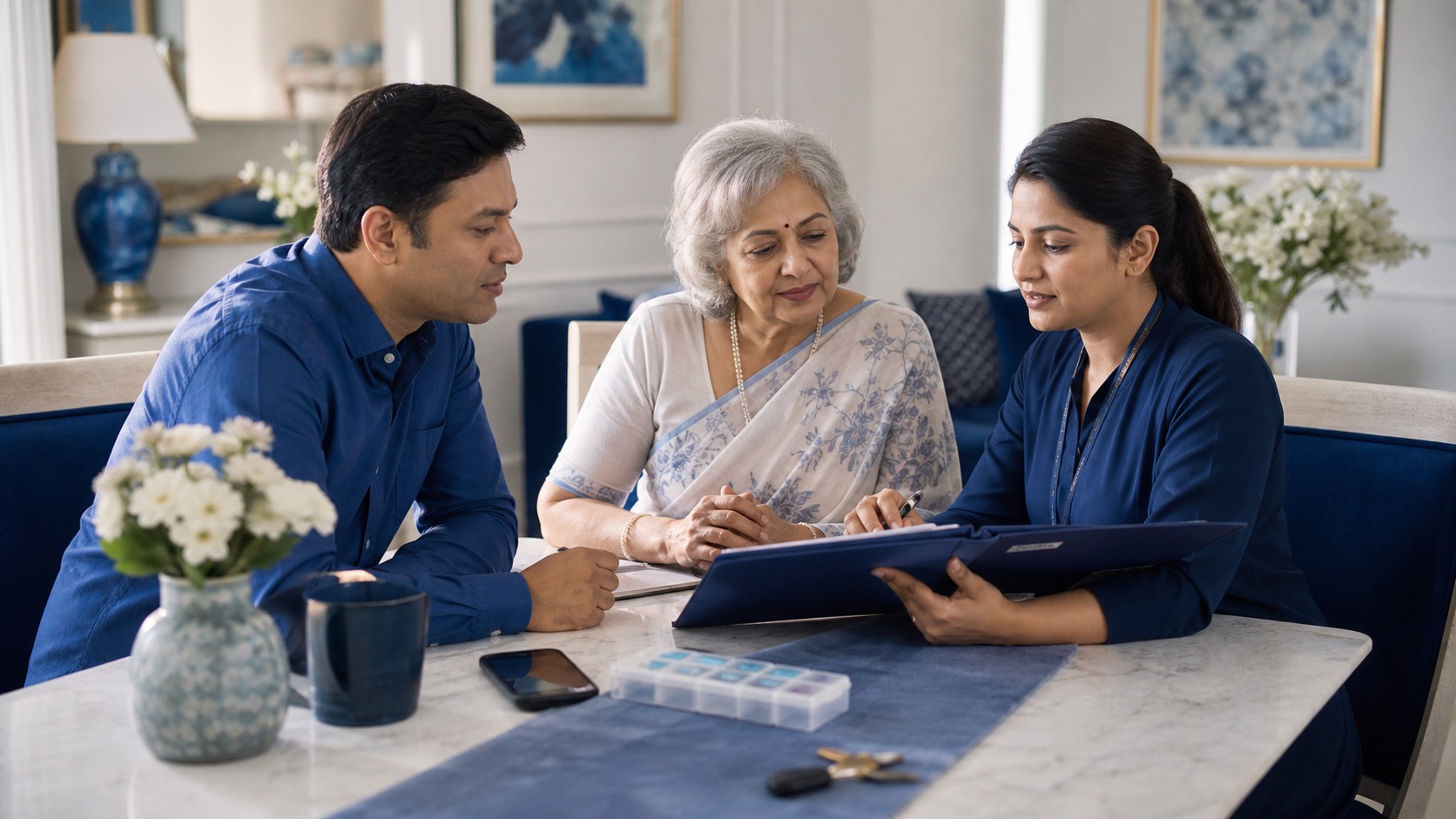 Living alone becomes safer only when access, records, responders, and escalation rules are already clear.
 NRI parent care works when overseas children, local responders, and parents share the same plan before a crisis.
 A senior community should be evaluated through daily life: walking routes, meals, response, dignity, and parent comfort.
At a glance
- Visible emergency sheet: One page with identity, address landmark, diagnoses, allergies, medicines, doctors, hospital, and call order.
- Door access protocol: Key holder, backup key, building permission, lock code rule, and what to do during a no-answer call.
- Responder sequence: Primary local visitor, backup visitor, hospital escort, doctor communicator, and family update owner.
- Current medicine list: Prescription, OTC, eye drops, supplements, dose, timing, purpose, prescribing doctor, and known side effects.
- Hospital folder: ID, insurance or scheme details, discharge summaries, test reports, prescriptions, allergies, and doctor list.
Questions families ask
Where should the emergency plan be kept?
Keep one visible printed sheet near the main door, refrigerator, medicine drawer, or bedside table. Keep the full folder in one fixed place and share a digital copy with the parent, local responder, and key family members.
Should neighbours have a key?
Only if the parent agrees and the neighbour is truly trusted. A safer version is a sealed key envelope, building-office protocol, smart lock code, or two-person access rule. Write who may enter, when, and who must be informed immediately.
What should NRI children do during a no-answer call?
Use the written sequence instead of repeated panic calls. Try the parent twice, contact the local responder, ask the building guard or neighbour to check, confirm whether the parent is at a clinic or temple, and escalate to emergency services if there is credible risk.
Is 112 enough?
No. Keep 112 in the plan, but also keep local ambulance, preferred hospital, doctor, building office, neighbour, driver, and Elderline 14567 where relevant. Real response depends on both public emergency systems and nearby people who can act quickly.
How often should the plan be updated?
Update it after any hospital visit, fall, new diagnosis, medicine change, helper change, address change, or new phone number. If nothing changes, test and refresh it every three months.
When does an emergency plan become insufficient?
When emergencies repeat, the parent cannot recover safely alone, access is delayed, medicines remain unreliable, food and hygiene fail, or the parent feels frightened at night, the family should review daily support, recovery stay, assisted living, or senior community options.