A practical kitchen audit for families checking reach, hot liquids, gas or induction, food safety, medicines, lighting, flooring, seating, supervision, and emergency response.
Quick Answer
A senior-friendly kitchen is not a luxury modular finish. It is a task plan that lets an older adult do the right level of cooking safely: making tea, reheating food, cutting fruit, filling water, taking medicines, arranging prasad, supervising a cook, or sitting nearby while family prepares meals. Families should audit reach, lighting, wet floors, hot liquids, flame or induction use, ventilation, food storage, medicine separation, emergency calling, and whether solo cooking is still appropriate.
Design safety note
This guide is educational and does not replace advice from qualified architects, accessibility consultants, occupational therapists, physiotherapists, doctors, emergency responders, or licensed care providers. If an older adult has repeated falls, dizziness, confusion, sudden weakness, injury, severe pain, breathing difficulty, or immediate danger, seek urgent local medical help.
easy zone
for daily items
Tea, cups, plates, water, snacks, medicines, and light cookware should be reachable without a stool or deep bend.
timer
for every cook
A simple timer reduces the risk of food being forgotten on heat during distraction or fatigue.
exit path
must stay clear
The elder should be able to leave the kitchen quickly without crossing clutter, wet mats, or a narrow helper path.
Start with tasks, not cabinets
For many older adults, kitchen participation is identity. Making tea, warming milk, offering prasad, choosing ingredients, or supervising a favourite recipe can preserve role and confidence. The answer is not always to ban the kitchen; it is to define which tasks are safe, which need supervision, and which should stop.
Families should write three lists with the parent: tasks the elder can do alone, tasks they can do with someone nearby, and tasks that should move to family, cook, or community support. This avoids both extremes: unsafe independence and unnecessary helplessness.
The audit should be done during real routines, not in an empty showroom. Watch the parent make tea, reach cups, lift a vessel, fill water, open the fridge, find medicines, wash a fruit, turn from sink to stove, and carry a cup to the dining area.
Build the easy zone
The most useful storage is not the biggest storage. It is the shelf, drawer, counter, and appliance zone the elder can use without climbing, bending deeply, twisting, or lifting from a poor angle. Daily items should live between roughly knee and shoulder height.
Keep light daily cookware, cups, tea supplies, plates, dry snacks, water bottle, reading glasses, and labelled medicines in predictable places. Heavy pressure cookers, atta containers, oil cans, and bulk groceries should not depend on the elder lifting from overhead shelves or the floor.
Drawers usually work better than deep lower cabinets because contents come out toward the person. Open shelves can help visibility, but only if they do not collect clutter, oil, and dust that make items harder to identify.
Control heat, flame, and hot liquids
Burn risk often comes from ordinary moments: loose sleeves near flame, a forgotten pan, a heavy kettle, a wet handle, a pressure cooker moved too fast, or tea carried across a slippery floor. The design should reduce the chance that one distracted moment becomes a crisis.
Gas, induction, microwave, electric kettle, and cooktop choices should be judged by the actual user. Induction can reduce some open-flame risks, but it may be unsafe if the elder is confused by controls, cookware, power cuts, or heat indicators. Gas may be familiar, but families must check knobs, flame visibility, ventilation, and shut-off routines.
Use visible timers, stable cookware, back burners where possible, pot handles turned inward, short or fitted sleeves, and a clear rule: if the elder leaves the kitchen during active cooking, the heat goes off first.
Treat food safety as elder safety
Older adults can become seriously ill from foodborne infections. Kitchen design should therefore support clean separation, safe storage, reheating discipline, and easy identification of dates, leftovers, and high-risk foods.
Families should check refrigerator organization, expiry labels, safe water access, separate boards or utensils for raw and ready-to-eat food, and whether the elder can read labels clearly. A full fridge with unlabelled leftovers is not abundance if nobody knows what is safe.
Medicines should not be mixed with spices, snacks, or lookalike jars. If medicines are taken near the kitchen or dining table, create a separate labelled medicine area with light, water, and a written schedule.
Make help easy without taking over
A family member, cook, caregiver, or community staff member may assist. The kitchen should allow another person to stand nearby without blocking the elder's exit, pushing them aside, or creating a collision while hot food is being handled.
A chair or stable perch near the prep area can keep participation possible during fatigue. But seating should not sit in the main trip path or require the elder to stand from a low, soft, unstable chair while holding hot liquid.
Emergency planning belongs inside the kitchen audit. A phone, call bell, or support point should be reachable. Family should know what happens if the elder feels dizzy, burns a hand, smells gas, forgets the stove, or cannot safely finish cooking.
Senior kitchen audit checklist
01
Observe one real routine
Watch the elder make tea or a simple snack. Notice reach, balance, light, confusion, hot liquid handling, and where they slow down.
02
Create a no-stool rule
Daily items should not require climbing. Move cups, plates, tea, snacks, light cookware, and medicines into easy reach.
03
Separate heavy storage
Pressure cookers, oil cans, grain containers, and bulk groceries should be handled by family, cook, or staff if lifting is unsafe.
04
Light the task, not just the room
Counters, stove, sink, fridge, medicine area, and dining surface need clear low-glare light without shadows from the body.
05
Audit wet floor behaviour
Check whether spills are visible, mats slip, footwear grips, and the elder can turn while holding tea or water.
06
Check the heat source honestly
Choose gas, induction, microwave, or kettle based on familiarity, cognition, power reliability, ventilation, and shut-off habits.
07
Use timers and shut-off routines
Active cooking should have a timer. If the elder leaves the kitchen, the burner or appliance should be turned off first.
08
Label food and medicines
Leftovers, expiry dates, spice jars, and medicines should be easy to read and kept in separate predictable zones.
09
Plan seated participation
Use a stable chair or perch for sorting vegetables, arranging prasad, or supervising food without standing through fatigue.
10
Keep help reachable
A phone, call bell, staff contact, or family response plan should be usable from the kitchen and dining area.
Kitchen decisions families should test
| Design feature | Why it matters | Family question |
|---|
| Solo cooking | Independence is valuable, but memory lapses, dizziness, weak grip, or poor vision can change risk. | Which tasks are safe alone, which need supervision, and which should stop? |
| Easy-zone storage | Climbing, deep bending, and overhead lifting increase avoidable risk. | Can the parent reach daily items without a stool, strain, or searching? |
| Hot liquid route | Tea, milk, dal, and boiling water create burn risk when carried across distance or wet floors. | Can hot liquid move from stove or kettle to table without turns, clutter, or slipping? |
| Gas or induction | The safer appliance is the one the elder can operate, understand, and switch off reliably. | Does the parent recognize heat, controls, cookware rules, flame, power cuts, and shut-off steps? |
| Task lighting | Poor light affects cutting, medicines, labels, spills, flame visibility, and expiry checks. | Is light falling directly on the work surface without glare or shadow? |
| Food storage | Older adults can be more vulnerable to serious foodborne illness. | Are leftovers dated, risky foods avoided, and raw and ready-to-eat items separated? |
| Emergency response | Burns, dizziness, falls, smoke, or gas smell need quick action. | Can the elder call help and leave the kitchen without crossing the hazard? |
Age-friendly design scenes to inspect
A good senior kitchen protects dignity by designing around real routines, not by pretending risk does not exist.
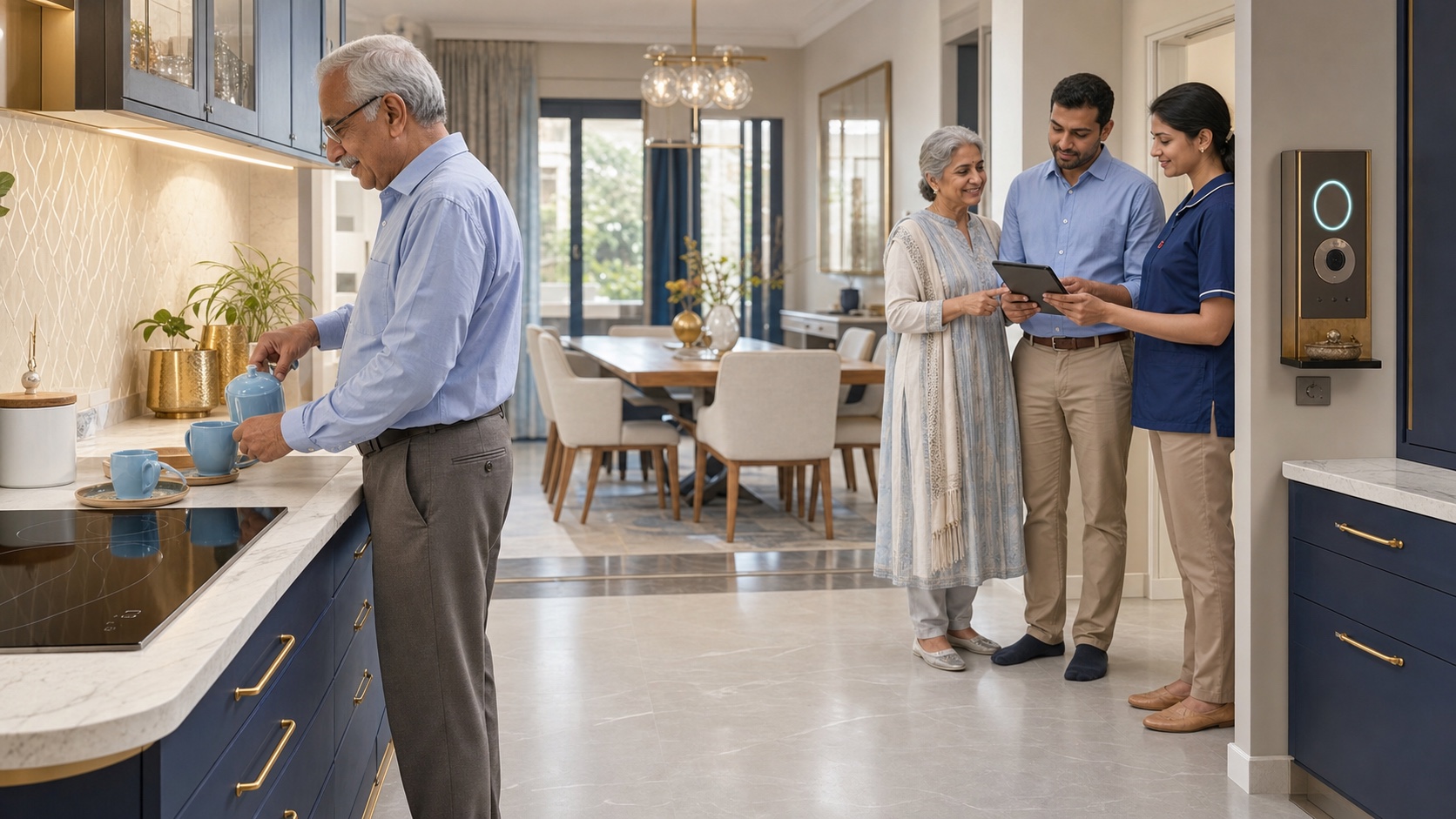 Independence improves when kitchens, entrances, call systems, and community response plans are designed as one support layer.
 Age-friendly design starts before a crisis: families should inspect movement, light, support, storage, response, and daily routine together.
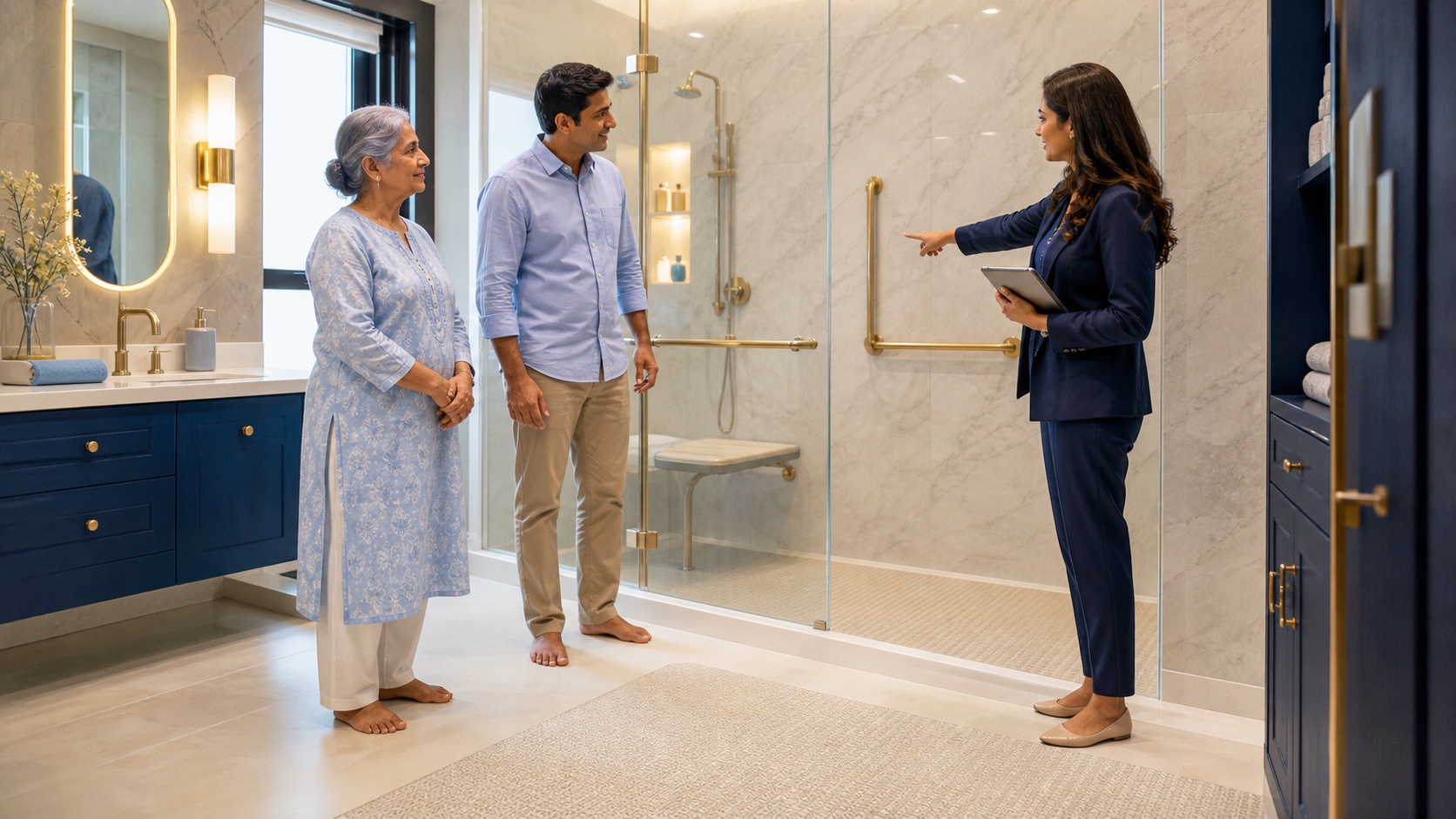 The bathroom is where small design details matter: dry reach, support points, non-slip surfaces, lighting, and space for assistance.
At a glance
Age-friendly design is quiet support
The strongest senior living environments do not make elders feel supervised or reduced. They make movement, rest, help, worship, meals, guests, and emergency response feel natural inside a beautiful home and community.
Questions families ask
Should older adults stop using the kitchen?
Not automatically. Families should divide kitchen tasks into safe alone, safe with supervision, and no longer safe. Many elders can still make tea, arrange prasad, sort vegetables, or supervise cooking when the kitchen is planned honestly.
When should solo cooking be reconsidered?
Reconsider solo cooking after repeated forgetting, dizziness, burns, falls, poor vision, unsafe lifting, confusion with knobs or induction controls, leaving food unattended, or inability to call help quickly.
Is induction always safer than gas?
No. Induction can reduce some open-flame risks, but it depends on user familiarity, cognition, cookware, heat indicators, power reliability, and supervision. The safest choice is the one the elder can use and switch off reliably.
What should be moved into easy reach first?
Move daily cups, plates, tea supplies, light cookware, snacks, water, glasses, medicines, and cleaning cloths before rearranging decorative or rarely used storage.
Why include food safety in kitchen design?
Older adults can have more serious illness from foodborne infection. Good design should make clean separation, refrigerator organization, reheating, expiry checks, and safe water access easier.
How can families preserve dignity while adding supervision?
Let the elder choose the tasks that matter most, keep them involved in decisions, create seated participation, and use support as backup rather than taking over every kitchen role.